I Tested ChatGPT Ads: Here's What Actually Worked
Author: Mariliis Uibomäe · Published: · Last updated:
In brief
In September I tested ChatGPT Ads with real B2B and SaaS campaigns. In my tests CTR ranged from 1.1% to 2.1% and CPC from €0.45 to €0.80, shorter and fully visible ad copy performed better, and 99% of impressions came from mobile. These are my own results, not market-wide benchmarks.
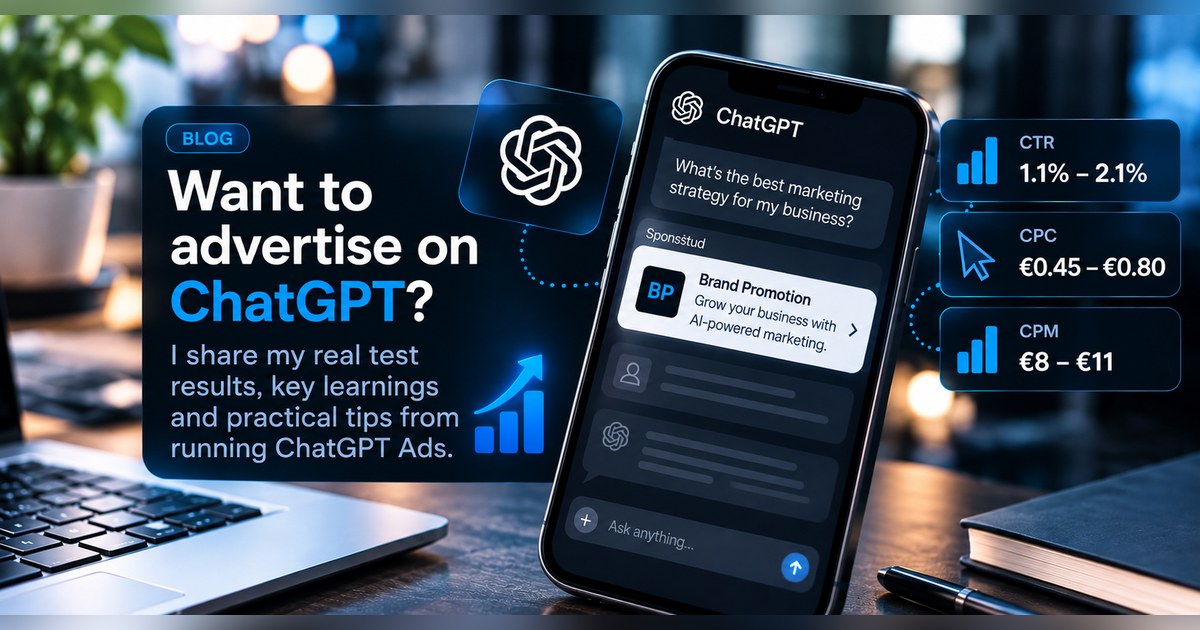
ChatGPT Ads is still a very new advertising channel. That also means there isn't much real campaign data or hands-on experience publicly available yet.
So instead of trying to predict how advertising on ChatGPT might perform, I decided to test it myself.
During September, I ran ChatGPT Ads experiments with both B2B services and B2B/B2C SaaS companies. I tested different ad copy, CPC bids and campaign setups to understand what actually affected performance.
Some of the results were expected. Others weren't.
One of the more interesting findings was that paying a higher CPC didn't necessarily improve my results. Shorter, fully visible ad copy, however, consistently performed better.
Here are the results and lessons from my first real ChatGPT Ads campaigns.
What are ChatGPT Ads?
ChatGPT Ads give businesses an opportunity to reach users within an environment where people often express their needs through conversations rather than traditional keyword searches.
That makes advertising on ChatGPT quite different from traditional search advertising or social media advertising.
On Google, someone might search:
“marketing agency Tallinn”
On ChatGPT, the same need could be expressed as:
“I'm running a small SaaS company and need help acquiring new customers. What kind of marketing partner should I look for?”
The commercial intent can exist in both cases. It is simply expressed differently.
From a performance marketing perspective, that makes ChatGPT Ads particularly interesting. An advertiser may be able to reach someone while they are researching, comparing solutions or asking for recommendations.
My first ChatGPT Ads results
Across my active September test campaigns, I saw the following ranges:
| Metric | My results |
|---|---|
| CTR | 1.1%–2.1% |
| CPC | €0.45–€0.80 |
| CPM | €8–€11 |
| Cost per conversion | €45–€58 |
These are results from my own test campaigns and should not be treated as market-wide ChatGPT Ads benchmarks. The conversion data in particular is still early and based on limited volume.
CPC, CPM and CTR nevertheless provide an interesting first look at the platform.
The more interesting insights appeared when I started looking at what actually changed performance between ads.
Shorter ChatGPT Ads copy performed better
This was the clearest pattern in my tests.
For the same offer, I tested three to four versions with a similar selling point but different copy lengths.
Shorter copy consistently won.
There was an important nuance, though.
It wasn't simply a matter of using as few characters as possible.
What seemed to matter was whether the complete key message remained visible in the ad preview.
Whenever the full sentence was displayed instead of being truncated, that version performed better in my tests on both clicks and cost.
So my first ChatGPT Ads best practice is surprisingly simple:
Always check the live preview before publishing an ad.
Don't rely only on the character allowance in the interface. Make sure your strongest selling point appears before anything gets cut off.
99% of my ChatGPT Ads impressions came from mobile
This may help explain why shorter copy performed better.
In my September campaigns, approximately 99% of impressions came from mobile devices. Most impressions were also generated within ChatGPT itself.
That has a direct impact on ad creative.
A long introduction followed by an explanation, value proposition and CTA might look perfectly reasonable while writing the ad.
On a phone, users may never see half of it.
For now, I would therefore treat ChatGPT Ads as a strongly mobile-first advertising format.
Did increasing my ChatGPT Ads CPC improve performance?
Not in my tests.
I experimented with different CPC bids, including the €0.50 minimum CPC.
The platform warned that this bid might be too low to remain competitive.
I expected traffic to suffer.
Instead, much of my traffic still came in at the minimum bid.
More importantly, increasing the bid didn't create an obvious improvement in quality. As long as the daily budget was being spent, performance remained broadly similar.
My current approach would therefore be:
Start low and let the actual campaign data tell you whether you need to increase your bid.
Don't voluntarily pay more simply because an advertising platform suggests that you should.
ChatGPT Ads targeting still feels like a black box
This is one area where I would like to see considerably more transparency.
In some cases, I could see the conversation context in which an ad appeared.
Naturally, I expected a highly relevant conversation to generate a noticeably stronger CTR.
I couldn't see a clear relationship in my tests.
CTR remained relatively similar whether the conversation context looked like a strong fit or a fairly loose one.
That doesn't mean context doesn't matter.
It simply means my current data isn't sufficient to say that apparent contextual relevance improved performance.
That's an important distinction when analysing a new advertising channel.
6 ChatGPT Ads best practices from my first tests
Based on the first campaigns, these are the principles I would start with:
- Keep your ad copy short. Get to the actual benefit quickly.
- Make sure the entire key message is visible. Always check the live preview.
- Think mobile-first. 99% of my impressions came from mobile.
- Start with a relatively low CPC bid. Increase it when the data gives you a reason.
- Don't overinterpret contextual targeting yet. The platform and reporting are still developing.
- Track conversions from day one. Cheap clicks don't make a channel profitable.
These are observations from my own early campaigns rather than universal ChatGPT Ads rules.
Are ChatGPT Ads worth testing?
For the right company, I think they are.
Not because ChatGPT Ads have already proven themselves to be better than Google Ads, LinkedIn Ads or Meta Ads. It's far too early to make that claim.
What interests me is where ChatGPT sits in the customer journey.
People use ChatGPT to research options, compare products and services, understand problems and ask for recommendations.
For B2B services and SaaS companies in particular, that makes the environment interesting.
My early CPC of €0.45–€0.80 also made experimentation relatively inexpensive.
For now, however, I would still treat ChatGPT Ads as an experimental acquisition channel rather than immediately moving a large share of an established Google or Meta budget into it.
Start small. Measure properly. Learn.
How should you measure ChatGPT Ads?
Don't stop at impressions and clicks.
At minimum, you should be able to follow:
ChatGPT Ad → website visit → meaningful website action → lead or purchase
That means setting up UTMs, GA4 and relevant key events before launching your campaign.
Depending on the business, that might include contact form submissions, demo requests, registrations, purchases, bookings or phone calls.
This is particularly important on a new platform where CTR and CPC benchmarks are still developing.
A €0.45 click isn't cheap if none of the visitors convert. A €2 click can be excellent if it generates a valuable customer.
What would I test next?
My September experiments gave me enough data to form some hypotheses, but not enough to call them definitive conclusions.
Next, I want to look more closely at creative and message testing, landing-page conversion rates, differences between B2B and B2C use cases and, most importantly, conversion quality rather than just volume.
I also want to revisit contextual targeting once there is enough data to determine whether stronger conversation relevance starts showing a clearer relationship with campaign performance.
ChatGPT Ads is still an early advertising platform.
And that's exactly what makes testing it interesting.
Frequently asked questions about ChatGPT Ads
How much do ChatGPT Ads cost?
There isn't one universal cost. In my September test campaigns, CPC ranged from €0.45 to €0.80 and CPM from €8 to €11. These are my own campaign results rather than platform-wide benchmarks.
What CTR do ChatGPT Ads get?
My campaigns generated CTRs between approximately 1.1% and 2.1%. Performance varied between campaigns and creatives.
What type of ChatGPT Ads copy works best?
In my tests, shorter messages where the complete key sentence remained visible performed better than longer versions that were truncated in the ad preview.
Are ChatGPT Ads mainly shown on mobile?
In my September test campaigns, 99% of impressions came from mobile devices. This is my campaign data rather than a claim about all ChatGPT Ads traffic.
Are ChatGPT Ads worth testing for B2B companies?
They can be an interesting experimental channel, particularly for B2B services and SaaS. I would start with a controlled budget and measure actual conversions and lead quality rather than judging performance only by CPC or CTR.
Ready to get started?
Need a clear marketing strategy or help with a specific channel? I'll work with you to craft a solution that actually delivers results.
Get in touch